2656 S.L West Suite # 360
Houston,Texas 77054.
Tel: (713) 663-6019
2440 FM 2234 Suite # 215
Missouri City, Texas 77459
Tel: (281) 499-6184
How Do I Choose And Use A Toothbrush?
Angled heads, raised bristles,
oscillating tufts and handles that change colors with use: you
name it, toothbrushes come in all shapes, colors and sizes, promising
to perform better than the rest. But no body of scientific evidence
exists yet to show that any one type of toothbrush design is better
at removing plaque than another. The only thing that matters is
that you brush your teeth. Many just don't brush long enough.
Most people brush less than a minute, but to effectively reach
all areas and scrub off cavity-causing bacteria, it is recommended
to brush for two to three minutes.
Which toothbrush is best?
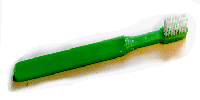
In general, a toothbrush head should be small (1" by 1/2")
for easy access to all areas of the mouth, teeth and gums. It
should have a long, wide handle for a firm grasp. It should have
soft nylon bristles with rounded ends so you won't hurt your gums.
When should I change my toothbrush?
Be sure to change your toothbrush, or toothbrush head (if you're
using an electric toothbrush) before the bristles become splayed
and frayed. Not only are old toothbrushes ineffective, but they
may harbor harmful bacteria that can cause infection such as gingivitis
and periodontitis. Toothbrushes should be changed every three
to four months. Sick people should change their toothbrush at
the beginning of an illness and after they feel better.
How do I brush?
Place the toothbrush beside your teeth at a 45-degree angle and
rub back-and-forth gently. Brush outside the teeth, inside the
tooth, your tongue, and especially brush on chewing surfaces and
between teeth. Be sure to brush at least twice a day, especially
after meals.
How long should I brush my teeth?
You should brush your teeth at least 2-3 minutes twice a day.
Brush your teeth for the length of a song on the radio, the right
amount of time to get the best results from brushing. Unfortunately,
most Americans only brush for 45-70 seconds twice a day.
Electric vs. manual toothbrushes
Electric toothbrushes don't work that much better than manual
toothbrushes, but they do motivate some reluctant brushers to
clean their teeth more often. The whizzing sounds of an electric
toothbrush and the tingle of the rotary tufts swirling across
teeth and gums often captivates people who own electric toothbrushes.
They are advantageous because they can cover more area faster.
Electric toothbrushes are recommended for people who have limited
manual dexterity, such as a disabled or elderly person and those
who wear braces. Sometimes, it takes more time and effort to use
an electric toothbrush because batteries must be recharged, and
it must be cleaned after every use. Most electric toothbrushes
have rechargeable batteries that take 10 to 45 minutes to recharge.
The gearing in an electric toothbrush occasionally must be lubricated
with water. Prices range from $30 to $99.
How do electrics work?
Electric toothbrushes generally work by using tufts of nylon bristles
to stimulate gums and clean teeth in an oscillating or rotary
motion. Some tufts are arranged in a circular pattern, while others
have the traditional shape of several bristles lined up on a row.
When first using an electric toothbrush, expect some bleeding
from your gums. The bleeding will stop when you learn to control
the brush and your gums become healthier. Children under 10 should
be supervised when using an electric toothbrush. Avoid mashing
the tufts against your teeth in an effort to clean them. Use light
force and slow movements, and allow the electric bristle action
to do its job.
How long have toothbrushes been
used?
The first toothbrush was invented in China in 1000 A.D. It was
an ivory-handled toothbrush with bristles made from a horse's
mane. Toothbrushes became popular in the 19th century among the
Victorian affluent. Mass marketing and the advent of nylon bristles
in the 20th century made toothbrushes inexpensive and available
to everyone.
Don't forget . . .
Visit your dentist regularly because toothbrushing and flossing
is most effective with periodic checkups and cleanings.