
|
|

PEDIATRIC DENTIST
PRACTICING IN HOUSTON AND MISSOURI CITY FOR 18 YEARS.
NOW ACCEPTING NEW PATIENTS.

CLICK
HERE TO ENTER THE DENTIST OFFICE
& BOOK YOUR APPOINTMENT TODAY!  OR E-MAIL
US!
OR E-MAIL
US!
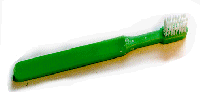
DENTISTS RECOMMENDATIONS.
You can have a good experience with dentistry
by making the right choice of a family dentist and by practicing
good oral health care at home between dental visits, Proper home
hygiene can reduce the costs of dental care by preventing dental
disease.
For successful dental care it is important to have a family dentist
who takes a sincere interest in the patient's general health.
It makes sense to select and become acquainted with a dentist
before a dental emergency arises. If you are a subscriber to one
of the newer dental benefit modalities such as dental HMO's and
capitation plans you will be limited in the number of dentists
from which to choose in any given area. Nonetheless the following
can still provide useful guidelines in the selection process.
It's Important To Put Your
Money Where Your Mouth Is
When most people think about health insurance, they think first
about covering costs of treatment for serious medical conditions
or accidents. That's a natural thing to do. But there's another
type of insurance that's equally important to your well being--dental
insurance. Because dental disease is so common, being protected
by dental insurance and using it wisely are essential safeguards
for you and your family.
There's A World Of Difference
Between Medical And Dental Disease...
Unlike medical disease, which can be both unpredictable and catastrophic,
most dental ailments are preventable. Preventive care, including
regular checkups and cleanings, is the key to maintaining your
oral health. With regular visits to the dentist, problems can
be diagnosed early and treated without extensive testing or elaborate
and expensive procedures. That keeps the costs of dental care
much lower than those of medical care. In fact, total spending
for dental care is decreasing. In 1970, it made up 6.3 percent
of total health care expenditures. But in 1991, dental care's
share of health care spending was only 4.9 percent.
...And Between Medical
And Dental Benefits
Medical insurance is designed primarily to cover the costs of
diagnosing, treating and curing serious illnesses. This process
may involve a primary care physician and multiple specialists,
a variety of tests performed by doctors and laboratories, multiple
procedures and masses of medications. Depending on the health,
age and attitudes of people in the medical coverage group, costs
can fluctuate widely.
Dental insurance works differently. Most dental coverage is designed
to ensure that the patient receives regular preventive care. High
quality dental care rarely requires the complex, multiple resources
often required by medical care. A thorough examination by the
dentist and a set of x-rays are all it usually takes to diagnose
a problem. By and large, dental care is provided by a general
practitioner, although some cases may require the services of
a dental specialist. Because most dental disease is preventable,
dental benefits plans are structured to encourage patients to
get the regular, routine care so vital to preventing and diagnosing
the onset of serious disease.
In fact, most dental benefits plans require patients to assume
a greater portion of the costs for treatment of dental disease
than for preventive procedures. By placing an emphasis on prevention,
and by covering regular teeth cleaning and check-ups, Americans
saved nearly $100 billion in dental care costs during the 1980s.
Dental Insurance Is Helping Keep America Healthy.
The availability of dental insurance is the single greatest factor
in helping you get the dental care you need. More than 48 percent
of all Americans--113 million of us--are covered by privately
financed dental insurance plans. This compares with just 12 million
people who had such coverage in 1970. As a result of increased
access to regular care and the widespread use of preventive measures,
the incidence of dental decay has dropped sharply. Half of today's
school children never have had a cavity.
Different Plans for Different Needs--Know the Differences
Consumers can choose from an assortment of dental benefits plans
that accommodate a variety of needs and expectations. The following
factors differentiate one plan from another:
1. the type of third party responsible for funding and administration
of the plan;
2. the alternatives offered for selecting a dentist;
3. the structure used to compensate the dentist for services provided;
and
4. the method by which benefits and payments are calculated.
Understanding these differences is essential to making an informed
decision when selecting a plan and using the benefits.
1. Third Parties
Regardless of the dental benefits plan, there are usually three
parties involved: you, the patient; the dentist providing care;
and a third party with whom you or your employer contracts for
coverage. If your options include a plan funded by your employer,
you may have an administrator responsible for processing and payment
of claims. The primary responsibility of the third party is to
provide the financial foundation for your dental benefits plan.
There are three types of third parties.
Dental Service Corporations. These not-for-profit organizations
negotiate and administer contracts for dental care to individuals
or specific groups of patients. Delta Dental Plan and Blue Cross/Blue
Shield Plans are examples of this third party type.
Insurance Carriers. These for-profit companies underwrite the
financial risk of, and process payment claims for, dental services.
Carriers contract with individuals or patient groups to offer
a variety of dental benefits packages, often including both fee-for-service
and managed care plans.
Self-Funded Insurers. These companies use their own funds to underwrite
the expense of providing dental care to their employees. The company
pays for the dental costs of its employees, usually with limitations
on services and fixed-dollar allocations.
2. Choosing a Dentist
Dental benefits plans can be categorized by the options offered
for selecting a dentist. Some plans allow you the freedom to choose
your own dentist, while others, in exchange for lower rates, limit
your choice. These two alternatives are called open and closed
panel plans.
Open Panel. This type of dental benefits plan allows covered patients
to receive care from any dentist and allows any dentist to participate.
Any dentist may accept or refuse to treat patients enrolled in
the plan. Open panel plans often are described as freedom of choice
plans.
Closed Panel. This type of plan allows covered patients to receive
care only from dentists who have signed a contract of participation
with the third party. The third party contracts with a certain
percentage of dentists within a particular geographic area. There
are two types of closed panel plans.
Preferred Provider Organization (PPO) - This plan allows a particular
group of patients to receive dental care from a defined panel
of dentists. The participating dentist agrees to charge less than
usual fees to this specific patient base, providing savings for
the plan purchaser. If the patient chooses to see a dentist who
is not designated as a "preferred provider," that patient
may be required to pay a greater share of the fee-for-service.
Exclusive Provider Organization (EPO) - This closed panel plan
allows a particular group of patients to receive dental care only
from participating dentists. Although there may be some exceptions
for emergency and out-of-area care, if a patient decides to see
a dentist which is not listed on the EPO panel, charges for service
will not be covered by the plan. Because participating dentists
are required to offer substantial fee reductions, many dentists
elect not to participate in EPO-type plans. Under some benefits
plans, participating dentists may be salaried employees of the
EPO. An EPO contracts with a limited number of practitioners within
a geographic area. Access to necessary specialized care can be
restricted. The EPO also may limit the amount of services that
a patient can receive in a given calendar year.
3. Paying The Dentist
When choosing a benefits plan, it is important to know who pays
what to whom. Dental plans can be categorized into three types
based on the compensation and treatment provided.
Indemnity Plans. This type of plan pays the dentist on a traditional
fee-for-service basis. A monthly premium is paid by the patient
and/or the employer to an insurance carrier, which directly reimburses
the dentist for the services provided. Insurance companies usually
pay between 50 percent and 80 percent of the dentist's fee for
covered services; the remaining 20 percent to 50 percent is paid
by the patient. These plans often have a pre-determined deductible,
a dollar amount which varies from plan to plan, that the patient
must pay before the insurance carrier will begin paying for care.
Indemnity plans also can limit the amount of services covered
within a given year and pay the dentist based on a variety of
fee schedules.
Capitation Plans.
This type of plan provides comprehensive dental care to enrolled
patients through designated provider dentists. A Dental Health
Maintenance Organization (DHMO) is a common example of a capitation
plan. The dentist is paid on a per capita (per head) basis rather
than for actual treatment provided. Participating dentists receive
a fixed monthly fee based on the number of patients assigned to
the office. In addition to premiums, patient co-payments may be
required for each visit.
Direct Reimbursement Plans. Under this self-funded plan, an employer
or company sponsor pays for dental care with its own funds, rather
than paying premiums to an insurance carrier or third party. The
patient pays the dentist directly and, once furnished with a receipt
showing payment and services received, the employer reimburses
the employee a fixed percentage of the dental care costs. The
plan may limit the amount of dollars an employee can spend on
dental care within a given year, but often places no limit on
services provided. Patients can select a dentist of their choice
and, in conjunction with the dentists, can play an active role
in planning the treatment most appropriate and affordable to ensure
optimum oral health.
4. Calculating Payments
A clear understanding of the methods used to calculate benefits
and payments will allow you to compare and evaluate the purchasing
power of different plans. The following are four common payment
schedules.
Capitation (per capita). This fee schedule is used by plans structured
to provide a predefined level of benefits. Because dental care
needs vary by individual, it is critical to have a thorough understanding
of the level or range of services "defined" or covered
by the plan. Under this fee schedule, the patient is responsible
to pay for treatment not covered within the scope of the plan.
In some cases, the allocated payment a dentist receives from the
benefits plan, including patient co-payments, is less than the
actual cost of providing care. Patients often settle for less-than-optimal
treatment alternatives or postpone necessary services when their
co-payments do not cover all possible options.
Table of Schedule of Allowances. Plans using this form of benefits
calculation establish a maximum dollar limit for each covered
procedure, regardless of the fee charged by the dentist. If you
select a plan that uses this type of table or schedule, ask how
often the table is adjusted for inflation or for changes in accepted
dental procedures. In these plans, the difference between the
allowed charge and the dentist's fee is paid directly by the patient.
Patients should understand that contracted fee reductions listed
in some plan allowance schedules can significantly diminish the
level and quality of care delivered. Contracted rates are based
on the size of the patient population and projections of the amount
and type of treatment performed within a given time frame. Since
cost control drives this payment approach, your ability to choose
your dentist or see a specialist may be limited.
Direct Reimbursement. In this self-funded plan, the patient pays
the doctor for services. The employer or plan sponsor reimburses
the employee for a predetermined percentage of all costs. Under
this fee schedule, the employee has an incentive to work with
the dentist to plan healthy and economical solutions.
Usual, Customary & Reasonable (UCR). Most indemnity (traditional
fee-for-service) plans use this payment schedule. It allows patients
to select their own dentist. The UCR schedule pays benefits based
on a fixed percentage of the lesser of the dentist's fee or the
fee determined by the insurance carrier to be "usual,"
"customary" or "reasonable" for the service
in the community in which the service was delivered. Wide fluctuations
in UCR fees between communities have made this payment system
highly controversial. Because many insurance carriers set the
UCR percentage too low in comparison to the area's usual professional
fees, patients may wind up paying more out-of-pocket. Most payments
are made directly to the dentist, but in some instances they are
made to the beneficiary.
Dental Plans Do Have Their
Limitations
Today's health insurance, including your dental plan, is designed
to help you get the care you need at a reasonable cost. Because
each person's oral health is different, costs can vary widely.
To control dental treatment costs, most plans will limit the amount
of care you can receive in a given year. This is done by placing
a dollar "cap" or limit on the amount of benefits you
can receive, or by restricting the number or type of services
that are covered. Some plans may totally exclude certain services
or treatment to lower costs. Know specifically what services your
plan covers and excludes.
There are, however, certain limitations and exclusions in most
dental benefits plans that are designed to keep dentistry's costs
from going up without penalizing the patient. All plans exclude
experimental procedures and services not performed by or under
the supervision of a dentist, but there may be some less obvious
exclusions. Sometimes dental coverage and health insurance may
overlap. Read and understand the conditions of your dental plan.
Exclusions in your dental plan may be covered by your medical
insurance.
The California Dental Association encourages consumers to choose
plans that impose dollar or service limitations, rather than those
that exclude categories of service. By doing so, you can receive
the care that's best for you and actively participate with the
dentist in the development of treatment plans that give the most
and highest quality care.
To help you stretch each dental benefit dollar, most plans provide
patients and purchasers with special administrative services.
Find out if your plan provides the following mechanisms to help
you budget, analyze and dispute, if necessary, the costs of your
dental care.
Predetermination of Costs. Some plans encourage you or your dentist
to submit a treatment proposal to the plan administrator before
receiving treatment. After review, the plan administrator may
determine: the patient's eligibility; the eligibility period;
services covered; the patient's required co-payment; and the maximum
limitation. Some plans require predetermination for treatment
exceeding a specified dollar amount. This process is also known
as preauthorization, precertification, pretreatment review or
prior authorization.
Although your dental benefits plan may not be bound to predetermined
costs, this mechanism can help you and your dentist plan and budget
a treatment plan appropriate to your oral health needs.
Annual Benefits Limitations. To help contain costs, your plan
may limit your benefits by number of procedures and/or dollar
amount in a given year. In most cases, particularly if you've
been getting regular preventive care, these limitations allow
for adequate coverage. By knowing in advance what and how much
your plan allows, you and your dentist can plan treatment that
will minimize your out-of-pocket expenses while maximizing compensation
offered by your benefits plan.
Peer Review for Dispute Resolution. Many plans provide a peer
review mechanism through which disputes between third parties,
patients and dentists can be resolved, eliminating many costly
court cases. Peer review is established to ensure fairness, individual
case consideration and a thorough examination of records, treatment
procedures and results. Most disputes can be resolved satisfactorily
for all parties.
Premium Adjustments and Reevaluations. Patients and plan purchasers
should insist on regular reviews of premium levels to ensure that
UCR or Table of Allowances payment schedules are equitable. This
analysis can help optimize your benefit levels, ensuring that
every dollar you spend is used wisely.
Coordination of Benefits. If you are covered under two dental
benefits plans, notify the administrator or carrier of your primary
plan about your dual coverage status. Plan benefits coordination
can help protect your rights and maximize your entitled benefits.
In some cases you may be assured full coverage where plan benefits
overlap, and receive a benefit from one plan where the other plan
lists an exclusion.
Eight Things To Consider
When Choosing Your Dental Plan
What looks like a bargain today may not be a good buy in the long
run. While your out-of-pocket costs are, of course, an important
part of your decision-making process when choosing a dental plan,
they are not the only criteria to use when evaluating your options.
Your primary focus should be to determine whether the coverage
will satisfy your dental care needs. Consider the following:
1.
Does the plan give you the freedom to choose your own dentist
or are you restricted to a panel of dentists selected by the insurance
company? If you have a family dentist with whom you are satisfied,
consider the effects changing dentists will have on the quality
or quantity of care you receive. Because regular visits to the
dentist reduce the likelihood of developing serious dental disease,
it's best to have and maintain an established relationship with
a dentist you trust.
2.
Who controls treatment decisions--you and your dentist or the
dental plan? Many plans require dentists to follow treatment plans
that rely on a Least Expensive Alternative Treatment (LEAT) approach.
If there are multiple treatment options for a specific condition,
the plan will pay for the less expensive treatment option. If
you choose a treatment option that may better suit your individual
needs and your long-term oral health, you will be responsible
for paying the difference in costs. It's important to know who
makes the treatment decisions under your plan. These cost control
measures may have an impact on the quality of care you'll receive.
3. Does the plan cover diagnostic,
preventive and emergency services? If so, to what extent? Most
dental plans provide coverage for selected diagnostic services,
preventive care and emergency treatment that are basic for maintaining
good oral health. But the extent or frequency of the services
covered by some plans may be limited. Depending upon your individual
oral health needs, you may be required to pay the dentist directly
for a portion of this basic care. Find out how much treatment
is allowed in any given year without cost to you, and how much
you will have to pay for yourself.
Every dental care plan is different. It's your responsibility
to be informed about what your specific plan will cover. As a
basis of comparison, the following services should be covered
in full, with no deductible or patient co-payment:
Initial Oral Examination--once per dentist
Recall Examinations--twice per year
Complete x-ray survey--once every three years
Cavity-detecting bite-wing x-rays--once per year
Prophylaxis or teeth cleaning--twice per year
Topical Fluoride treatment--twice per year
Sealants--for those under age 18
4. What routine corrective treatment is covered
by the dental plan? What share of the costs will be yours? While
preventive care lessens the risk of serious dental disease, additional
treatment may be required to ensure optimal health. A broad range
of treatment can be defined as routine. Most plans cover 70 percent
to 80 percent of such treatment. Patients are responsible for
the remaining costs. Examples of routine care include:
Restorative care - amalgam and composite resin fillings and stainless
steel crowns on primary teeth
Endodontics - treatment of root canals and removal of tooth nerves
Oral Surgery - tooth removal (not including bony impaction) and
minor surgical procedures such as tissue biopsy and drainage of
minor oral infections.
Periodontics - treatment of uncomplicated periodontal disease
including scaling, root planning and management of acute infections
or lesions
Prosthodontics--repair and/or relining or reseating of existing
dentures and bridges.
Understand what routine dental care is covered by the plan, and
what percentage of the costs will come our of your pocket.
5.
What major dental care is covered by the plan? What percentage
of these costs will you be required to pay? Since dental benefits
encourage you to get preventive care, which often eliminates the
need for major dental work, most plans are not generous when it
comes to paying for major dental work, most plans cover less than
50 percent of the cost of major treatment. Most plans limit the
benefits--both in number of procedures and dollar amount--that
are covered in a given year. Be aware of these restrictions when
choosing your plan and as you and your dentist develop treatment
best suited for you. Major dental care includes:
Restorative care--gold restorations and individual crowns
Oral Surgery--removal of impacted teeth and complex oral surgery
procedures.
Periodontics--treatment of complicated periodontal disease requiring
surgery involving bones, underlying tissues or bone grafts.
Orthodontics--treatment including retainers, braces and/or diagnostic
materials.
Dental Implants--either surgical placement or restoration
Prosthodontics--fixed bridges, partial dentures and removable
or fixed dentures.
6.
Will the plan allow referrals to specialists? Will my dentist
and I be able to choose the specialist? Some plans limit referrals
to specialists. Your dentist may be required to refer you to a
limited selection of specialists who have contracted with the
plan's third party. You also may be required to get permission
from the plan administrator before being referred to a specialist.
If you choose a plan with these limitations, make sure qualified
specialists are available in your area. Look for a plan with a
broad selection of different types of specialists. If you have
children, you may prefer a plan that allows a pediatric dentist
to be your child's primary care dentist. Since specialized treatment
is generally more costly than routine care, some plans discourage
the use of specialists. While many general practitioners are qualified
to perform some specialized services, complex procedures often
require the skills of a dentist with special training. Discuss
the options with your dentist before deciding who is best qualified
to deliver treatment.
7. Can you see the dentist when you need to, and
schedule appointment times convenient for you? Dentists participating
in closed panel or capitation plans may have select hours to see
plan patients. They may schedule appointments for these patients
on given days, or at specified hours of the day, restricting your
access. Some dentist's fees for seeing you on weekends or during
emergencies are high than those the plan allows. You may be required
to pay additional costs yourself. If you select these types of
plans, have a clear understanding of your dentist's policies as
well as the plan's dentist-to-patient ratio. It's the best way
to ensure your access to care is not unduly restricted and that
you are not surprised by higher fees the plan does not cover.
8.
Will the plan provide benefits to patients who may also be covered
by another dental plan? It is not unusual to be eligible for dual
benefits. You may be covered under your company's plan as well
as under that of your spouse's employer. In analyzing your options,
make sure to look for a plan that allows coordination of benefits.
You should be entitled to either 100 percent coverage or some
form of premium credit. By coordinating benefits, you can eliminate
being penalized or denied coverage when the two plans have conflicting
exclusions.
Getting The Best And Most
From Your Plan
To take full advantage of your dental benefits plan, visit the
dentist regularly and get the preventive care that will keep your
mouth healthy. Follow the treatment plan you and your dentist
have developed. Do your dental homework--brush and floss regularly
and maintain a regular schedule of oral examinations and teeth
cleanings.
Should you need treatment for particular conditions, follow the
procedure for predetermination required by your plan. Find out
what your insurance will cover. Feel free to discuss a payment
plan with your dentist for your portion of the treatment costs.
Making An Informed Choice
The law mandates that consumers with dental coverage receive a
fully detailed patient information handbook--a Description of
Benefits--that clearly outlines coverage, limitations and exclusions.
Before selecting a plan that best suits your needs, ask your carrier
or company benefits coordinator for a copy of the benefits handbook.
If you have questions about coverage, exclusions, calculation
of benefits or payment of benefits, ask before making your plan
selection. Find out which plans your dentist participates in and
why. That's the best way for you to get care from the dentist
of your choice, and still take advantage of the costs savings
due to you.
Selecting an insurance program wisely isn't simple. But having
the facts to make an informed decision can make a difference.
No plan is perfect; each has its advantages and limitations. Read
the fine print. And by all means ask questions. The more you know
about dental benefits, the better equipped you will be to select
the best coverage for your dental health.
The information provided should not be construed as either an
endorsement or recommendation by CDA. While this brochure attempts
to be comprehensive, there may be questions that it has not answered
fully. Consult your insurance carrier, insurance broker or company
benefits coordinator for complete information.
childrens
dentist dentist
kids
dentist pediatric
dentist houston
dentist dentists
dentist
dentistry missouri
dentist dentist
directory family-dentist
family-dentistry
family
pediatric dentist oral
dentist teeth
dentist
checkup brush
teeth tooth
fairy tooth
ache hygiene
smiles
molars
search
engines | backgammon |
its new online | make
money online | online
casino | internet
gambling